Shopping does have some benefits

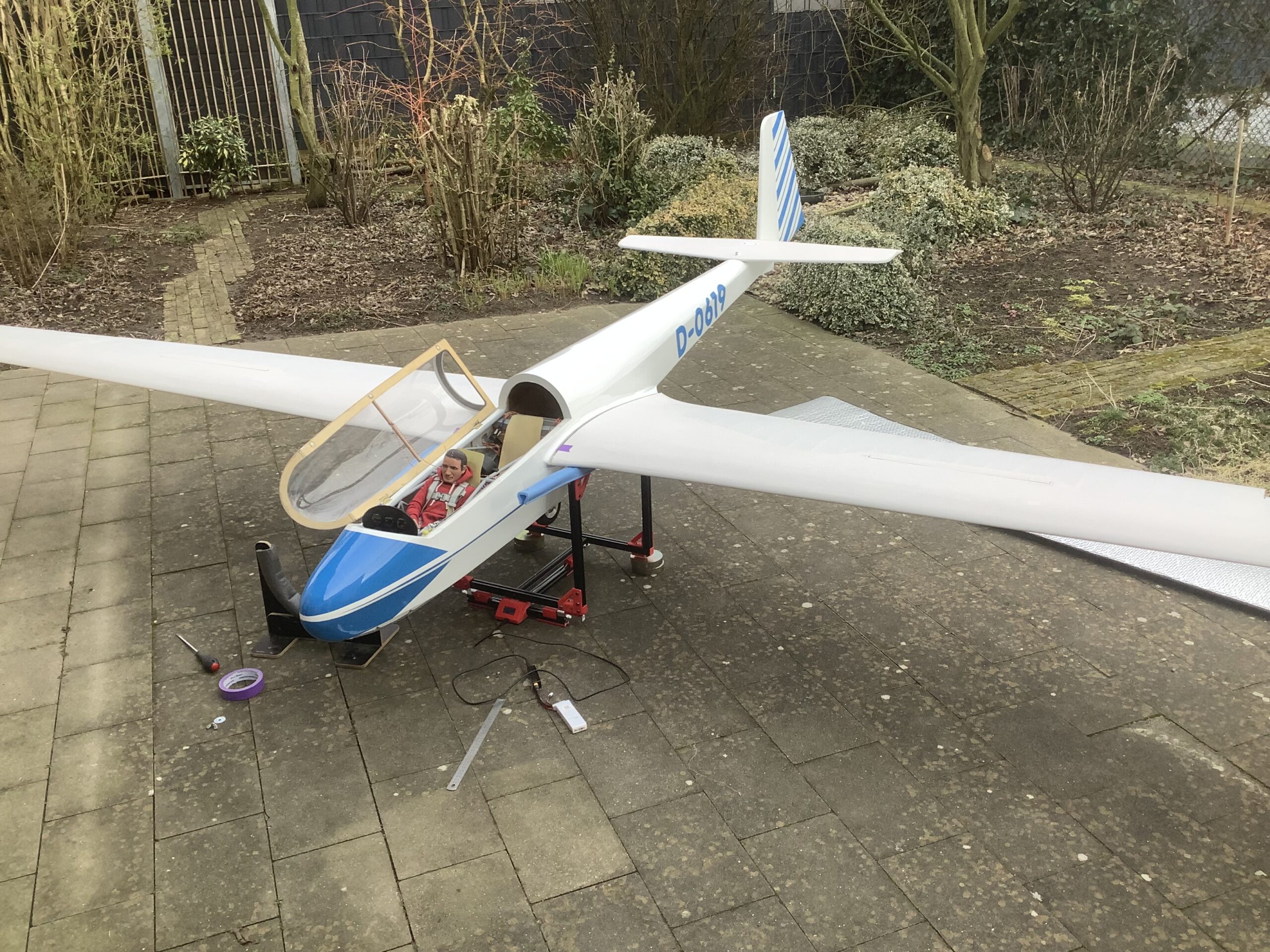
While visiting the local furniture emporium, my eyes caught some glittery stuff. Turned out to be underlay, a thin mylar covering with a good 4 mm foam attached to it. I immediately could se a better use for this stuff: Great for making wingbags!!

Since the foam melts when heated, it’s pretty simple to make your perfect wingbag! The golden look certainly makes it stand out, and who knows, it might keep your wings hot/cold, depending on the season..

Making my own wingbags for Xmas.

Making my own wingbags for Xmas.

Anyway, wishing you all a merry Christmas and a happy New Year

Kees 


Ol’ Yak takes to the air again..

Yak at Herwen

Another Happy Saturday. The Yak finally was ready for take-off again. It’s probably been more or less a full year since the last flight at Tyrella. I had ordered a 24/10 for the MVVS/EVO-58, since the manufacturer recommends up to 26/10. In the event, the props did not arrive, and a quick dash to a local shop had to be planned to get at least something to put up front. Erik Grutten from BigPlanes helped out and found me a 23/8 and for the future, a 26/10. Looks massive, and I surely will have to check my ground clearance!  As always with a new/unfamiliar engine, you might as wel forget installing the cowl until you get things going. After the usual hard work, the engine finally got going. One thing I discovered is the effectiveness of the choke. 1 flip only, or you end up with a swimmingpool.  Anyway, after everything started to make happy noises, and a slight leaning of the bottom end, things sounded airworthy. As before, the Yak does not need a lot of space to get airborne, and the first flight was spend doing loopings etc, to give the engine a bit of a workout. Landing in the crosswind was not too much of a problem, but since I oiled my wheel-bearings, the rollout was impressive. Of course the engines idle-rpm was a tad high, things being all brand spanking new.  I have now tightened de wheel bolts, to allow a bit of additional friction. Hope this  helps with the rollouts. Second flight I got a bit more adventurous with some verticals and wingovers. The engine runs nice, and feels like it is going to be much fun.

Thinking about the amount of fuel coming out of the carb when choking, I came up with a solution that serves two purposes. 1st collect the fuel, second to add an airfilter. In order to extend the carbhousing I installed an ancient OS-61 tuned pipe header that has been looking at me for the last 15 years. It proves again, that you should never throw anything away, because one day, you will have a good use for it!  The carb bolts were long enough, and the hole in the header was exactly the right size, as were the mounting holes. In short, this was exactly the right part for the job!  Since the carb sits at an angle on the engine, and the header had the same angle, the resulting stub ended up being exactly horizontal. Ready for the next bit, an discarde fuel-tank. This was to be the airfilter. Add a few holes, approx double the size of the carb hole and presto. Somehow is all fitted almost as if I had designed it this way. Scary.

The filter material is something we used to use in some of the machinery I work with, it’s supposed not to release any loose bits. Time will tell.  And of course the real question: does it work? After today I can say: absolutely no problem so far. Funny enough, the engine seemed a bit richer today, but this could also be caused by getting looser (3 liters so far). Whatever happens, it certainly does not reduce power!

When I’m happy that the filter bit works, I’ll close the top of the cowl, that will reduce the carb noise further we hope. I do think the tone of the engine is already different from what I’m used to, but it’s hard to say exactly what it is that makes it different.

Next weekend I hope to try the slightly larger 24/10, in order to reduce the rpm’s and noise a bit. I also need to get some of the Maibom material, to lag the cowl. And last but not least, when all that is done, do something with the exhaust, like get a real one! Of course that means hacking a bigger hole in the bottom of the fuse, and tidy up the LG, maybe add the wheel pants again, in short, plenty to do!

Lol, just having a look at the original MVVS manual, not the one that came with my 2008 EVO version.. I notice you can officially rotate the cab 90 degrees, to make access to the various levers easier (dooohh) en different needle settings. That explains a lot!! Typical man, never RTFM until absolutely necessary. Looking at it, I’m sure you can do a 180 rotation of the carb too, just redrill the pressure hole to be at the bottom of the case again. Ok, next time.

Next time came soon: I did what I should have done first time: rotated the backplate to sort that carb problem. Had a few flights to confirm things are happy: 7200 0n a Mejzlik 23*8.  Yep, that’s right on top of the power peak, and it lets you know too ;-)

Switched to a Xoar 23*10 and got approx 6200, with a much reduced noise level. But this being a wooden stick, does not help. A Mejzlik 24*10 is on order, it should quiet down things further. (Got approx 3 liters left of my running in juice, so I’m not going all out yet)

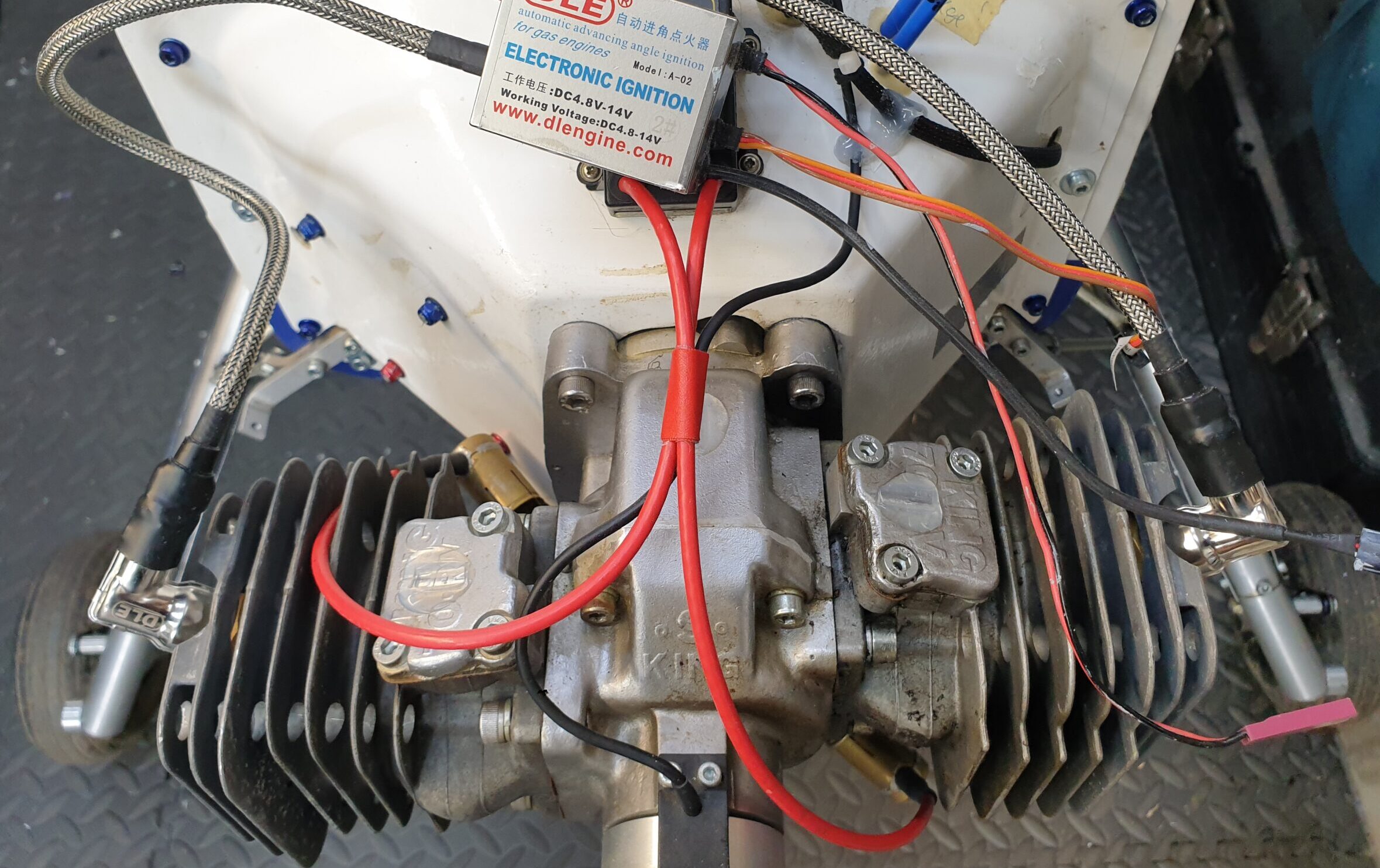
Today, again, for no good reason, all of a sudden the engine refuses to start, after a few good flights. Since I’d done my share of poluting the air for the day, I decided to have a closer look at home. My little voice has been telling me for weeks to have alook at the ignition, more specifically at the cap. After removing the heatshrink tubing (original, it was glued on properly!) I got this: Even from a distance it looks dodgy. (remember, it’s a gifted horse, one does not ask questions!)  I think I havebeen lucky, since most of the shielding is gone. The additional grounding wire probably saved me. Since I had a replacement I decided to take things apart further. My replacement unit has a 1k resistor, so I wanted to check the value of the original resistor. It appears to be a nice quality wirewound one. Actually, it used to be a nice one, since it read infinite.. Fiddling with it, it occasionally gave me a reading, but mostly nothing. Given the erratic behavior of the ignition, I decide for now that this is the problem.

An hours worth of fun, and we have somthing that should last at least a flight or 2. The replacement cap is the one sold by DLE, it is not made for the thicker HV cable used on the MVVS. But after testing, sparks appear at the correct place, so we try.

As they say, tomorrow is another day..

Update: had a dozen or so fligths now, all is still happy, no more flame outs so far. The 24*10 really feels nice, and somehow it even improves the snaps, it makes ‘em more controlled (if I can say that) Annoyingly I have a small leak in my exhaust pipes, which I have not located yet. Rebrazing an oily pipe is not much fun, and probalby will not result in ‘no more leaks’.

That’s some Easter!!

It’s reported to have been the warmest Easter in many years, and boy did I enjoy it. Went for a drive on Saturday, when my misses thought she spotted a plane. Never to miss an opportunity, I hit the brakes and went to investigate. What I found on the other side of the dike was this little bit of heaven..

And best of all, it’s like 15 mins from my present hideout! Lucky enough I had the Wotsit in good enough shape to have a bit of fun. I also did fly my Cougar, but got a bit concerned when most of the elastic bands started snapping. (dried out etc). If nothing else, it will make me move a bit getting the ol’ Yak ready. Which is easy, I mean, all I need is the prop. Which is in what box again? And a bit of solder to finish off the exhaust. Where did I put that stuff again? And so the fun goes on and on.. Makes you want to just go out an by a nice simple electric something…
Apparently, the noisy season runs from April till October, then the powerboats on the lake are banned, and so is the noise from the air. So, one way or another, I will need to consider electrifying myself.

Of course finding this site will delay unpacking stuff, but who cares. enjoy the weather while it lasts, is the present motto.


View Larger Map

Pigs did fly..

Another very nice day, where even a Blaster in the right hands can do the unthinkable: Fly higher then Loet’s Tantalium!! (Thanks Itse, for showing beyond a shadow of doubt, there’s nothing wrong with the Blaster, it’s simply the driver!) It does not matter it was just one flight and that Loet was actually trying real hard to stay below me, but hey, a man has to feel good once and a while!

I’ve reduced my El>Flaps mix even futher tonight in the dead-calm air, just before sunset. I applied G_T’s recipe (see previous post), he says ‘a bunch of loopings’. I managed 7 and a bit before chickening out. That should be enough for my present skills. Also added a bit of gravity again (before the loop test) and I just feel it flies better having a tad more control, and not constantly waddling about on the edge of stall.

I also spend a some time trying to find out the best way to circle (in dead air) At present I can put the inside wing horizontal, and with just the tiniest amount of up, it will circle flat, and not loose a lot of altitude. Circles are maybe 10 meter in diameter. This is also with flaps ‘neutral’, rather then in thermal mode. There must be a similar sweet spot for ‘flaps down a bit’.

Flaps down for breaking are down to 90% form 80% today. It does give me better breaking. And tweeked the elev. mix to go with it. In still air, this works nice now, no excessive balooning, nice steady angle coming down, could even use a tad more down to keep speed up. And the elasticator works great too, I’m getting the hang of it. I managed my 10 catches tonight, first time ever. Yeah, I know, dead easy when there’s no wind..

And of course, here’s the proof that even Blasters could do well today in the hands of an expert: Itse is at the controls going up, me on the controls coming down. Wonder why? 

Figured out from the last flights today, that with flaps in neutral, hardly any wind, I sink rate is approx 40cm/sec, which seems a lot!

This likely also tells me I need to fly a bit faster..  One more thing to worry about ;-)

I should really write down my present settings and CofG, otherwise I still won’t be any the wiser!

I made a quick test-template in a spreadsheet, but I should have used something else to draw. Never mind, all in good time.

It’s surprising how complicated the mix really is, and I already see a mistake or two in my setup. (As in limiting things at the wrong places. Dialing through the menus does not make that very apparent. All in all, ailerons are the most difficult, because a lot of stuff gets mixed in. I’ll do a similar one Elevator, Rudder, Flaps etc..

Posted in DLG

Bit of a grey day, so time to t(h)inker..

                                                                                                                                            Some other ‘stuff’ took precendence today, therefore I did not get my ‘fix’. In order to make up for it, I decided to spend an hour or so ‘thinkering’.  One fo the things I have been working on these last few evenings is catches. Of course, I started on the wrong side (no surprise there) by using the settings ‘for the mountains’, where I needed to come down at 45 degrees, in order not to overshoot the ridge I was flying from. Watching the Bemmel Boys these last few weeks, I notice they use a lot less flaps then I do/did. Therefore I decided to reduce my flap-travel as well, since at this stage I simply try to copy the masters, in de hope some of it will rub off. The results are less breaking, and a bit more landing speed, which is not bad. One (to me) annoying thing was that during the last meter or so, I would reach out to catch the plane, but I forget most times to raise the flaps. 

A few times it has happened that I was just a meter short, when with flaps raised, I could have performed a nice catch. (Yes, I know, fly a bit faster etcetc.. My brain just seems to be programmed at present to always leave me short by exactly 1 meter. 

Anyways, to help with that, and to be ready one day to be able to catch and throw, I need something that resets the flaps. Lucky for me, someone invented the elasticator. Hidden deep inside the tranny is now such a magic piece of material. Now, when I let go of the flaps-stick (throttle for noisy-plank flyers) it automagically goes ‘up’ again. And all that took longer to write then to execute..

I already reprogrammed the tranny to give me snap-flaps (up elev give a bit of down-flaps), which should help in circling. So far, I’ve not found any conditions that allowed me to see the effects. The air has been pretty unexciting these last few evenings.  Of course mixing ‘a bit’ is the usual TLAR. However, there’s a chap out on rcgroups, Gerald T, who appears to be very knowledgable about these things!

He suggests:

This test is for fine tuning the total elevator throw and the elevator to flap coupling.

Put the plane in cruise mode and build up a little speed. Not super fast. Basically a short dive is fine.

Now pull full up elevator. If the plane does big loops then add a little more max up elevator. If the plane tries to loop tight but mushes out quickly, then there is too much elevator available. The wing can’t support the AOA the elevator is trying to force. It is stalling. Reduce the elevator slightly.

Now lets suppose the max elevator travel is reasonable so a tight loop can be done without the plane mushing out immediately. It might not be efficient and may only make a few loops before dying, but that is fine.

Now, generally one doesn’t use full up elevator except in emergencies. What you have done is set the emergency elevator setting. More than that doesn’t accomplish anything so more than that is prevented. But there is as much as we can get away with.

In normal flying even in tight turns and aerobatic playing, we are using less than 100% throws. We try to stay in the more efficient range to conserve energy. So write down your up elevator max position and trim position, and then back off the max up elevator to perhaps 90% of what it was. Or perhaps even 80%. Just pick your poison.

Now the max up elevator should be in the efficient range, more or less. Now we want the wing to match up with this, to be as efficient as it can be.

So pick some starting number, such as a 3% mix. Now the flaps don’t move very far with the reduced full up elevator. Put it in cruise and dive it to build up a bit of speed. Now from this point on, for each dive in the test, duplicate how long you dive. Consistency will matter a little for the test.

Suddenly pull full up elevator. Count the number of loops that you get before the plane fails.

By the way, if the loops tilt over towards a side as they continue, then there is some cross aileron and rudder trim that should be removed, or perhaps there is a wing/fuselage alignment issue, or perhaps there is a wing warp. Fix those things.

Now make a slight increase, to perhaps 4% mix. Count the number of loops. Now 5%. Get the picture? Find what percentage mix gives the best energy retention -> the most number of loops. For a modern unlimited for instance, the number of loops can be unlimited. For a DLG, it should be greater than 6 but it may not be for all planes. It probably won’t be greater than 9.

Now set the elevator max back to the previously determined value. Do the loop test one more time, but this time hold the stick at about the 80 to 90% full up elevator position, to duplicate the previous test position. Count the loops. If it does fewer or slightly larger, then add just 1% to the elevator->flaperon mix.

That’s it.

By the way, the mix can be different for different default camber settings. For instance, one might want less up flaperon for down elevator in speed mode, and less down flaperon for up elevator in float/thermal mode. And in speed mode one would likely be aiming for bigger faster loops.

That’s one non-modeling based field setting approach. I hope it is of some use. I won’t call it perfect and technically it is not correct but it certainly gets one in the ballpark. It is quick and easy to do.

Gerald

Do a search on his name, you will find a lot of very interesting posts!

Happy Saturday

Saturday, Wind 2 m/s, 2% cloud, around 12:00. It does fly..

It does fly..On a day like this there’s lots of happy faces!And look here!! Even the birds were having a ball of a time. Looking back at this trace, I can honestly say I did not think I was this high. I am still flying with CofG just behind the rear-wing mounting screws. It’s realy not comfortable flying, but eventually I found the right spot on my flaps/elevator. When I had enough of this experience, I just raised the flaps to launch setting, so ca 0.5 degrees reflexed. I’m amazed how much/how fast I lost altitude!  I was certainly not in a dive. Memo to self: Check this & make sure there is nothing ‘silly’ dialled in on the Tranny! In the mountains, speed was just that, speed, but no dropping down so fast. For easy of flying I later removed the 1 gram external ‘gravity’ from the tail, it makes things a bit easier for now. I’m back on the rear screws again. Next I want to work on my circling, I did find a good spot, both left and right turns today. I prefer to fly with rudder, and the turns were nice and tight, without loosing altitude but I easily fall out if not careful. Once into the turn with a little bit of rudder, I need opposite aileron to stop me spiralling in. Talking about small amounts here.  I will have to work on that first. (Bad habit.. once into the turn, let go of rudder! Rudder on a wing with Dihedral is like using Ail… I should know better! ) Ideally I would like (probably not when skills change): Upgoing aileron should provide enough drag to keep the turn nice, and enough ‘up’ to keep the nose on the horizon. Maybe worth trying more diff, so that downward ail is a bit smaller then now. If I only use Up aileron, that ‘should’ cause a pitching up as well.  If all else fails, I could fake it with a bit of an Ail > Elev mix.. (just to try of course.) Tomorrow’s forecast is good, so get y’r batteries charged!

And my clame to small fame:

Sunday update: What a bummer. Even stones were flying and I stuggle to get off the deck!! Guess my CG is not QuiteRight!! I’m going back to where I was (if I can find it). I have reset the tranny, since I messed too many things up. We pretends we have a brand new Blaster, and  start the program from scratch! One good in a hundred. I must improve the odds of that happening!

One good in a hundred. I must improve the odds of that happening!

Posted in DLG

CockpitSx-FrSky

Ah, the wonderful MPX CockpitSX. It has just been rebuild with a FrSky module. Below a few pictures to go with the modification. First is the proof that this a legitimate module (there’s a proper FCC number on the back, so you can look up the details if you want: It’s XYFD8TD8R).

As to the ‘which module wire goes where’ I can be short. Black is minus, Red is plus, Yellow is the signal (pulse) and there is a jumper between Brown and the pin next to it, to switch the tranny permanently to ‘Trainer’ mode. The black numbers refer to the pin numbers on the Charging/Trainer socket.

The biggest challenge is always ‘where do I put the antenne?’. As luck has it, the answer is: Where it is supposed to be, ie, where your 35Meg antenna oncee lived.

To gain access to this location you need to remove a bunch of screws from the PCB (make a note where they go, otherwise you will end up with a few spare ones.) and remove the PCB. Be careful, it is plugged into the bottom PCB at the rear.  Once the PCB is loose, you need to undo the screws that hold the original antenne fitting.  You will then see a hex-brass part with wire soldered to it. That’s your standard antenne wire. Since we never want 35 MHz again, the best idea is to unsolder it from the PCB. (don’t leave it dangling!)

Remove original antenna fitting

Now for the good part: The new antenna connector fits into the place just vacated! It has exactly the same dimensions as the brass part you just removed.

Fitting the new antenna connector

(and I just realise where those 4 extra screws go that I had leftover!)  The black part that holds the antenna, also holds the display, so be careful handling all this.  After reassembly you will see that this case was designed for 2.4GHz!

connector fits snugly

After this, it is mainly an ‘reassemble in reverse order. The only thing left is to find a place for your module and the small pcb that holds the Leds and the bind button. Here is where I cheated. I already had gone through the pain of installing a small push button in the front of the tranny, for my previous Spektrum conversion, so I simply used that again. For the same reason I had modified the rear case to accept the bottom half of the spektrum module. It was a see through box. So I simply velcroed the small PCB in a suitable location, and job’s done! And while I

Launch to cruise button

was at it, I added a push button on the back of the tranny, which allows me to switch from launch to cruise by simply releasing the button. It’s a lot easier to get a more accurate lauch (he says hopefully)

There is one warning though: 2.4GHz wiring is delicate, extremely delicate. Do take a lot of care NOT to stress, pull, or bend the coax (gray antenna wire) If you mess this up, you can buy a new module! If you need more details, let me know.

.. a backside like this will confuse the judges!!